What Nightlife & Entertainment Taught Me About Reading an Audience
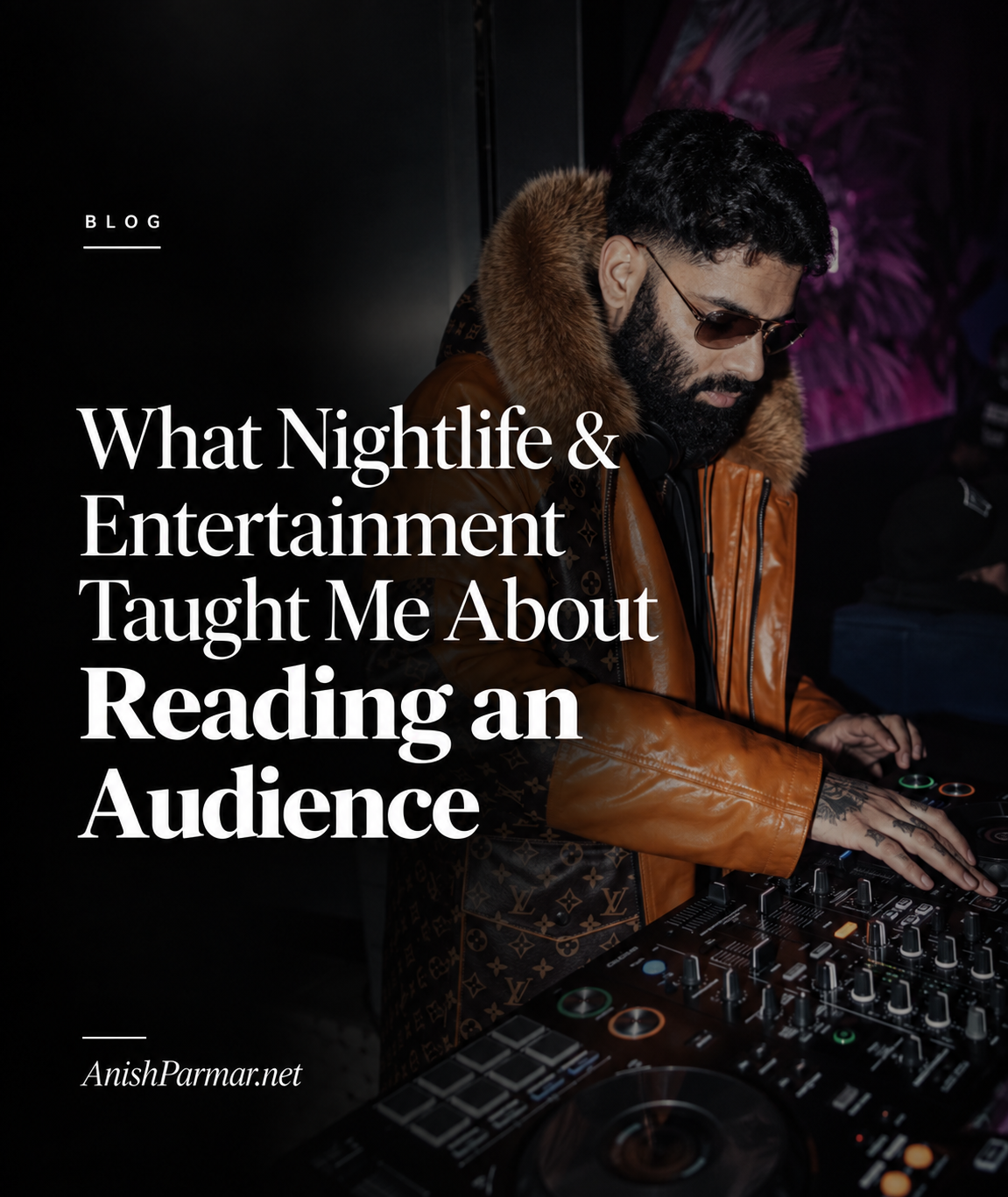
Working in nightlife and live entertainment has taught me something that has carried into almost every other part of my work: people rarely tell you exactly what they want, but they usually show you.
In a live environment, there is no strategy document explaining how the room feels. You have to observe behaviour, recognise changes in energy and make decisions in real time. Whether I am working behind the decks, within hospitality or at a corporate event, the audience is constantly giving signals.
That experience has influenced how I think about marketing, public relations, branding and business. In each case, understanding the audience comes before deciding how to communicate with them.
Audiences Are Constantly Giving You Signals
A live audience communicates through behaviour.
People move closer to the action. They become more engaged. They leave for the bar. They start recording. They recognise something familiar. They lose interest. The atmosphere changes as different groups enter or leave the room.
Individually, those reactions can mean very little. Collectively, they start to reveal a pattern.
The skill is not simply noticing what people are doing. It is understanding what those actions mean within the context of the environment.
That distinction is important in business too.
A single complaint does not necessarily represent an entire customer base. One successful piece of content does not automatically reveal a permanent strategy. A sudden increase in attention can be useful without proving that the underlying positioning is strong.
The wider pattern matters.
The Loudest Person Is Not Always the Audience
Nightlife teaches you very quickly that the most vocal person in the room is not necessarily representative of everybody else.
Someone may insist on hearing a particular genre or track, while the wider room is responding well to something completely different. Listening to individual feedback can be useful, but allowing one opinion to dictate the experience can easily take the entire environment in the wrong direction.
The same principle applies online.
One negative comment can feel disproportionately important. A vocal minority can create the impression that an entire audience thinks the same way. Businesses can react too quickly to isolated feedback and change something that was working perfectly well.
Good audience understanding requires perspective.
Listen to people, but also watch what the broader audience actually does.
Context Changes Everything
The same entertainment approach will not work in every environment.
A corporate event is different from a nightclub. A luxury retail event is different from a private function. A hospitality venue at 9pm requires something different from the same venue after midnight.
The audience changes.
The expectations change.
The purpose of the environment changes.
That means the correct decision depends heavily on context.
This is something I have carried into my work outside entertainment. A marketing strategy that works for one company might make no sense for another. The tone that works for a nightlife brand might feel completely inappropriate for a professional services business.
There is rarely one universally correct approach.
There is an approach that is correct for that audience, in that environment, at that moment.
Timing Matters More Than People Think
You can make the right decision at the wrong time and still get a poor result.
In entertainment, timing affects everything. Something that works brilliantly later in the evening can feel completely misplaced earlier on. Raising the energy too quickly can leave nowhere to go. Changing direction too suddenly can disrupt momentum that was already working.
I see the same thing in PR and business.
A strong announcement can be wasted if the company is not ready for the attention.
A founder may try to position themselves as an authority before there is enough evidence supporting that position.
A brand can launch a campaign before its website, messaging or customer journey is capable of converting the interest it creates.
The idea itself might be good.
The timing is wrong.
Strategy is often about knowing when to act, not simply knowing what to do.
You Cannot Operate at Maximum Intensity Constantly
One of the easiest ways to weaken a live experience is trying to make every moment feel like the biggest moment of the night.
If everything is a peak, nothing feels like a peak.
Audiences need contrast.
There are moments to build energy, moments to maintain it and moments to allow the room to breathe before increasing it again.
The same issue appears constantly in marketing.
Every post becomes urgent.
Every campaign is described as huge.
Every announcement is revolutionary.
Every piece of content is trying to demand maximum attention.
Eventually, the audience stops responding because there is no contrast left.
Attention becomes stronger when it is used selectively.
Familiarity Creates Trust
Audiences often respond strongly to things they already recognise.
That familiarity creates confidence.
In entertainment, you can use something recognisable to establish trust before moving into a less predictable direction. The audience becomes more willing to follow because you have already demonstrated that you understand the room.
Brands work in much the same way.
A complicated idea becomes easier to communicate when it is connected to something familiar. A new service becomes easier to understand when the customer can relate it to a problem they already recognise.
Innovation does not always need to mean unfamiliarity.
Often, the strongest creative work combines something people already understand with something they did not expect.
Execution Should Serve the Audience
Entertainment can become highly technical.
There are countless ways to demonstrate skill, creativity and knowledge. But technical ability only matters when it improves the audience's experience.
This is something I think applies to almost every creative industry.
Agencies sometimes become more interested in showing how sophisticated their strategy is than whether the strategy actually works.
Designers can become more interested in demonstrating creativity than whether the customer understands the website.
Marketers can build complicated funnels when a simpler route would perform better.
Entertainment works the same way.
Skill should support the objective.
It should not become the objective.
Behaviour Often Tells You More Than Feedback
People are not always good at describing what they actually respond to.
Someone may say they want one thing and consistently engage with another. A customer can describe a preference that is contradicted by their purchasing behaviour. An audience can request something and then react far less strongly than expected when it actually happens.
This does not make feedback useless.
It means feedback needs to be considered alongside behaviour.
In nightlife, you learn to observe what actually happens when you change direction.
Does engagement increase?
Does the atmosphere improve?
Do people stay?
Does attention rise or fall?
Business owners should ask similar questions.
What customers do can sometimes reveal more than what they say.
Small Adjustments Can Produce Large Results
Not every problem requires a complete change of direction.
In entertainment, a small adjustment can completely alter the atmosphere. Changing the pace, moving into another style at the right moment or simply allowing something to continue for longer can be enough.
I see the same principle in reputation and branding.
Sometimes a company does not need a complete rebrand.
The positioning may simply need clearer language.
The website may need better structure.
The biography may need updating.
The media strategy may need to become more selective.
The search presence may need more current information.
Individually, those adjustments can look minor.
Together, they can change how the entire brand is perceived.
Momentum Is Valuable and Fragile
There are moments in live entertainment when everything begins working naturally.
The audience is engaged.
The atmosphere feels right.
Each decision seems to build on the previous one.
That is momentum.
Once you have it, the objective changes slightly. You are no longer trying to create the reaction from nothing. You are trying not to interrupt what is already working.
Businesses experience the same thing.
A company begins receiving good press. Its search presence improves. Customers understand the positioning. Referrals increase. The brand becomes easier to recognise.
That momentum has real value.
The mistake is assuming it will continue without maintenance.
Consistency, quality control and restraint all become important.
Sometimes knowing what not to change is just as valuable as knowing what to change.
Live Environments Teach Fast Decision-Making
One of the things I value about entertainment is that decisions often have immediate consequences.
There is very little time to overthink.
You observe what is happening, make a decision and then respond to the outcome.
That process teaches you to become comfortable operating without perfect information.
Entrepreneurship is similar.
You can research.
You can analyse.
You can plan.
Eventually, a decision still has to be made.
Waiting indefinitely for certainty can be just as damaging as making the wrong choice.
The important skill is being able to act, observe the result and adjust when necessary.
Recovery Matters More Than Perfection
Things go wrong in live environments.
A decision does not land as expected.
The atmosphere changes unexpectedly.
Technical problems happen.
A transition in energy feels wrong.
The important part is how quickly you recover.
Most people will forget a small mistake far more quickly than the person responsible for making it.
Business is no different.
Not every campaign works.
Not every idea deserves to continue.
Not every decision produces the result you expected.
Problems become more expensive when people refuse to adapt because they are emotionally committed to the original plan.
Recognising when something is not working and correcting it quickly is a valuable skill.
The Best Entertainment Is Not About Personal Taste
Having taste and an individual style matters.
But professional entertainment cannot be built entirely around personal preference.
There are things I enjoy personally that would make no sense in certain environments. Equally, there are choices I would not necessarily make outside work that can be exactly right for a particular audience.
Professionalism means understanding that distinction.
The same applies to branding and marketing.
The founder's personal preference is not always the customer's preference.
The agency's preferred creative direction is not automatically the strongest option.
The client's request is not always what the audience will respond to either.
The strongest outcome often comes from balancing identity, context and audience response.
Different Audiences Require Different Languages
Working across different musical and entertainment environments has also reinforced how differently audiences communicate.
Genres have their own references.
Industries have their own language.
Communities have different expectations.
Cultural context matters.
You cannot approach every group in exactly the same way and expect the same response.
Businesses face the same challenge.
A founder communicating with investors speaks differently from a hospitality brand communicating with customers.
A public relations campaign targeting business publications requires different positioning from content aimed at a consumer audience.
The fundamental message can remain consistent while the language changes.
Understanding that distinction makes communication considerably stronger.
Attention Is Often Emotional Before It Is Rational
People frequently respond before they consciously understand why they are responding.
A familiar sound can create an immediate reaction.
An atmosphere can change because of something subtle.
Recognition, anticipation and association all influence how people feel.
Marketing behaves similarly.
People notice presentation.
They notice social proof.
They notice familiarity.
They notice status.
They notice emotion and association.
The rational explanation often comes afterwards.
This does not mean brands should manipulate audiences.
It means businesses should recognise that decisions are not made entirely through logic.
Perception matters.
Reading an Audience Means Respecting It
The phrase "reading the room" can sometimes sound like trying to control people.
I see it differently.
It is primarily about listening.
You are recognising that the audience has its own expectations, preferences and energy.
The objective is not to force people into whatever direction you decided beforehand.
It is to understand enough about the environment to guide the experience intelligently.
That same principle applies to communication more broadly.
Strong marketing does not need to trick people.
Strong PR does not need to manufacture importance.
Strong branding does not need to pretend.
The strongest work usually starts with understanding what an audience values and communicating something genuine in a way that connects with them.
How This Influenced CorpDJs
These lessons are part of the thinking behind CorpDJs.
The business operates across corporate events, hospitality, private functions, nightlife and branded experiences, environments where simply playing music is not enough.
Presentation matters.
Context matters.
Reliability matters.
Understanding the client matters.
Most importantly, understanding the audience matters.
A corporate event may require restraint and adaptability. A nightlife environment may require faster reactions to changes in energy. A private event can contain several generations and very different musical expectations within the same room.
The ability to read those differences is what turns entertainment into a professional service.
Why These Lessons Still Matter to Me
Nightlife, entertainment and my work in media operate in very different environments.
One happens in front of a live audience.
The other often happens through websites, publications, search engines, campaigns and digital platforms.
But many of the underlying principles are surprisingly similar.
You observe.
You look for patterns.
You understand context.
You make decisions.
You test.
You adapt.
You learn when to push and when to hold back.
You recognise that something successful in one environment may fail completely in another.
Most importantly, you remember that the audience ultimately decides whether something connects.
That is probably the most valuable lesson I have taken from working in entertainment.
You cannot demand a reaction. You can only create the conditions for one.
Whether I am thinking about a live event, a brand, a piece of content or a reputation strategy, I continue to come back to the same principle:
Understand the audience first.
Everything else becomes easier after that.